
Authentication is often the dependency teams assume will just be there. Then a regional disruption, configuration issue, or failed dependency reminds everyone that users cannot reach a healthy application if they cannot sign in.
Cloud modernization programs usually focus on compute, databases, and deployment pipelines first. That is understandable, but identity can quietly remain a single point of failure. With Amazon Cognito now offering multi-Region replication, teams have a new reason to revisit authentication resilience as part of application modernization rather than treating it as an afterthought.
Context: identity is part of your resilience architecture
For many teams, the modernization roadmap is familiar: containerize services, move workloads to managed platforms, decouple monoliths, introduce event-driven patterns, harden databases, and automate infrastructure. These are valuable efforts. But if your application depends on a single-region identity provider configuration, your availability story may still have a gap.
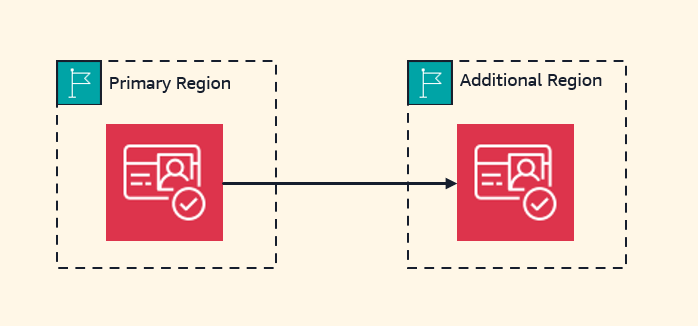
Amazon Cognito is commonly used for user sign-up, sign-in, identity federation, and user pool management across web and mobile applications. According to the AWS News Blog post, Improve your application resilience with Amazon Cognito multi-Region replication, Cognito now supports multi-Region replication that automatically synchronizes user data, credentials, and user pool configurations to a secondary AWS Region. AWS says this enables uninterrupted authentication during disruptions.
That is a meaningful change because authentication state is not just another stateless service. It includes user records, credentials, attributes, app clients, policies, triggers, and configuration details that must remain consistent enough for users and applications to continue operating during a failover event.
The hidden single point of failure in modernization plans
A typical resilient cloud architecture may include multi-AZ databases, autoscaled compute, regional backups, object replication, global DNS, and queue-based buffering. Yet the login path often remains anchored to one identity endpoint, one set of user pool settings, and one operational runbook.
This creates several risks:
- The application may be technically available while users are unable to authenticate.
- Disaster recovery plans may restore application data but not identity state.
- User pool settings may drift between environments or Regions.
- Teams may not know whether tokens, callbacks, hosted UI settings, custom domains, or Lambda triggers behave correctly after failover.
- Recovery time objectives may ignore the time required to re-create or reconfigure identity infrastructure.
For CTOs and engineering leaders, the lesson is straightforward: application resilience must include the complete user journey. If login, token refresh, password reset, or federated sign-in fails, the business experience is down even when the service health dashboard looks green.
What Cognito multi-Region replication changes
The new Cognito capability directly addresses one of the hardest parts of authentication disaster recovery: keeping a secondary Region ready.
Per AWS, Cognito multi-Region replication automatically synchronizes user data, credentials, and user pool configurations from a primary Region to a secondary Region. Instead of relying entirely on custom export jobs, manual configuration recreation, or incomplete infrastructure templates, teams can operate with a replicated identity layer designed for regional resilience.
User data and credentials
User data and credentials are central to continuity. If users need to reset passwords, re-register, or wait for a restore during a disruption, the application is not truly resilient. Automatic synchronization reduces the operational burden of keeping identity state current in another Region.
This matters for both customer-facing and internal applications. In customer-facing systems, failed login means lost revenue and support load. In internal tools, failed authentication can delay incident response, operational workflows, and administrative access during the exact moment teams need those systems most.
User pool configuration
Configuration replication is just as important as user data. A user pool is not only a database of identities. It includes sign-in policies, MFA settings, app clients, attribute schemas, message templates, domain configuration, federation settings, and integrations.
Configuration drift is a classic modernization problem. Teams often discover during incidents that the standby environment is almost correct, except for one missing callback URL, one outdated certificate, or one Lambda trigger pointing to the wrong function. By synchronizing user pool configurations, Cognito multi-Region replication can help reduce that class of failure.
A stronger foundation for uninterrupted authentication
AWS says the feature enables uninterrupted authentication during disruptions. Engineering teams should treat that as an architectural opportunity, not a reason to skip validation. Multi-Region replication improves the foundation, but your application still needs routing, failover behavior, dependency readiness, observability, and regular testing.
In other words, Cognito replication can remove a major identity-layer obstacle, but resilience still depends on the surrounding system.
Authentication DR belongs in modernization work
Modernization is not just rewriting code or moving workloads to Kubernetes. It is the ongoing work of removing fragility from systems that matter. Authentication disaster recovery is a strong candidate for modernization because it sits at the intersection of architecture, security, operations, and user experience.
Define recovery objectives for identity
Many organizations define RTO and RPO for databases but not for authentication. That creates ambiguity during planning and incident response.
Teams should define:
- How long can users be unable to sign in?
- How much identity data loss, if any, is acceptable?
- Which authentication flows are mission-critical?
- Do password reset, MFA enrollment, and federation need the same recovery targets as basic sign-in?
- Are administrative users covered by the same identity dependency?
Once these objectives are explicit, teams can evaluate whether Cognito multi-Region replication, plus their routing and application design, meets business requirements.
Map the full authentication path
Authentication resilience is more than user pool replication. A practical review should map every dependency in the login path:
- DNS and custom domains
- TLS certificates
- Hosted UI or custom login pages
- App client IDs and secrets
- Callback and logout URLs
- Identity federation providers
- Lambda triggers and their dependencies
- Email and SMS delivery paths
- MFA flows
- Token validation logic in downstream services
- API gateways, load balancers, and edge routing
This mapping often reveals that the identity provider was only one part of a larger regional chain. For example, a pre-token-generation Lambda trigger may depend on a regional database. A custom login page may call an API deployed only in the primary Region. An application may hard-code Region-specific issuer values without a failover strategy.
Treat failover as a product behavior
From a user perspective, failover is not an infrastructure event. It is a product behavior. Users expect to sign in, continue a session, or recover access without understanding which AWS Region is active.
That means engineering teams should test authentication failover the same way they test checkout, onboarding, or account recovery. Synthetic sign-in checks, token refresh tests, and canary users can help detect issues before real users are affected.
Practical implications for engineering teams
Cognito multi-Region replication is a timely modernization trigger. Here are practical actions teams can take.
1. Inventory authentication dependencies
Start by documenting which applications, APIs, mobile clients, internal tools, and admin portals depend on each Cognito user pool. Include environments, Regions, app clients, callback URLs, identity providers, and runtime assumptions.
This inventory is maintenance work, but it pays off quickly. It helps teams identify duplicate pools, outdated configurations, unused app clients, and unsupported flows.
2. Review infrastructure as code coverage
Even with managed replication, infrastructure as code remains important. Teams should confirm that user pools, app clients, domains, Lambda triggers, IAM permissions, DNS records, and application configuration are represented clearly and reviewed consistently.
This is where broader modernization practices apply. Pulumi articles on building repeatable EKS environment factories and comparing infrastructure-as-code approaches reinforce a useful principle: resilience improves when environments are reproducible, reviewable, and automated. The same principle applies to identity infrastructure. If authentication settings are managed manually, drift is likely.
3. Design the application for regional identity failover
Applications may need changes to support a secondary Cognito Region cleanly. Review token issuers, JWKS discovery, OAuth configuration, domain routing, and client-side assumptions. Mobile applications deserve special attention because configuration updates may depend on app releases.
Where possible, avoid hard-coding Region-specific authentication details deep inside application logic. Centralize identity configuration, make failover behavior explicit, and ensure observability can distinguish between primary and secondary Region authentication.
4. Test realistic failover scenarios
Do not limit testing to whether a secondary user pool exists. Test end-to-end flows:
- New sign-in
- Token refresh
- Password reset
- MFA challenge
- Federated sign-in
- New user registration, if applicable
- Administrative access
- API authorization after failover
Run tests under controlled game days. Capture failures as modernization backlog items, not one-off incident notes.
5. Update runbooks and ownership
Authentication spans platform, security, application, and support teams. A good runbook should specify who decides to fail over, what signals trigger action, which customer communications are needed, and how to validate recovery.
Also define how teams return to normal operation after a disruption. Resilience planning often focuses on failover, but failback can introduce its own risks if traffic, data, or configuration assumptions are unclear.
What CTOs should ask next
For technology leaders, Cognito multi-Region replication is an opportunity to ask sharper questions about modernization maturity:
- Is identity included in our critical dependency map?
- Do our stated availability targets include authentication?
- Can we prove our login path works during a regional disruption?
- How often do we test authentication failover?
- Where could user pool configuration drift still occur?
- Are application teams aware of identity-layer recovery objectives?
These questions are not just technical. They affect customer trust, incident cost, compliance posture, and release confidence.
Conclusion: resilient authentication is now table stakes
Amazon Cognito multi-Region replication gives modernization teams a stronger managed option for reducing authentication as a regional single point of failure. By automatically synchronizing user data, credentials, and user pool configurations to a secondary AWS Region, the feature helps close a gap that many cloud resilience plans leave unresolved.
The next step is not simply enabling replication and moving on. Teams should use this moment to review authentication dependencies, define recovery objectives, automate configuration, and test failover as part of normal engineering practice. Modernization is most valuable when it removes hidden fragility, and identity is one of the most important places to start.