
When production breaks, the hardest part is often not fixing the issue. It is figuring out what changed, what is correlated, which signal matters, and who needs to act before customer impact spreads.
That is why AI-powered incident triage is becoming more than an alerting upgrade. It is emerging as an operational-maintenance layer that connects observability, runbooks, service ownership, incident history, and controlled remediation workflows.
From alert noise to operational intelligence
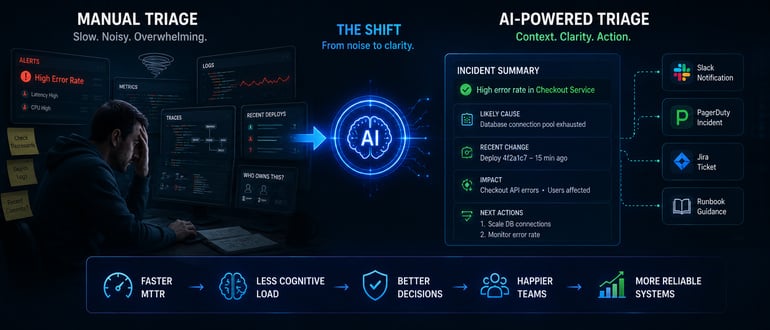
For years, many teams treated monitoring as a necessary but fragmented safety net. Metrics lived in one tool, logs in another, traces in a third, deployment history somewhere else, and tribal knowledge in Slack threads or postmortems that nobody searched during the next outage.
The result was a familiar pattern: users experienced degradation, alerts fired, engineers jumped between dashboards, and the incident channel filled with questions. What changed? Is this a dependency issue? Did a deployment cause it? Are we seeing one noisy symptom or multiple related failures?
DevOps.com captures this shift in The End of Manual Triage, describing how SRE teams are replacing manual incident triage with AI-assisted correlation, stronger observability, and controlled agentic workflows. The key word is controlled. The goal is not to let autonomous systems make risky production decisions without oversight. The goal is to compress the investigation window by connecting signals faster than humans can manually pivot across systems.
A related DevOps.com piece, From Reactive Monitoring to AI-Driven Operational Intelligence, frames the same problem from the monitoring side. Traditional monitoring often meant chasing alerts and toggling between dashboards after an issue had already impacted users. AI-driven operational intelligence attempts to move teams closer to real-time context: what is abnormal, what changed, what depends on what, and what response path is most likely to help.
For maintenance and modernization teams, this matters because incident triage is not just an operations workflow. It is an ongoing maintenance burden created by system complexity, aging architectures, inconsistent telemetry, undocumented dependencies, and stale operational knowledge.
AI triage is not just smarter alerting
It is tempting to view AI incident triage as the next generation of alert deduplication. That understates the change.
A basic alerting upgrade might group similar alerts, suppress duplicates, or enrich notifications with ownership metadata. Those improvements help, but they still assume humans will manually reconstruct the incident from raw evidence.
An operational-maintenance layer does more. It links signals across the software lifecycle:
- Recent deployments, feature flags, and configuration changes
- Service maps and dependency graphs
- Logs, metrics, traces, and events
- Known errors and previous incident records
- Runbooks and remediation steps
- Ownership, escalation, and on-call context
- Change management and compliance evidence
When AI-assisted triage works well, the system does not merely say CPU is high. It can suggest that error rates increased after a specific rollout, that the affected service depends on a degraded upstream API, that a similar incident happened three months ago, and that the approved runbook recommends disabling a feature flag before rolling back the full deployment.
That is operational maintenance in action. The AI is not just interpreting telemetry; it is helping maintain the connection between system behavior, institutional knowledge, and safe response procedures.
Expedia STAR shows where the market is heading
Expedia Group recently introduced STAR, an internal AI-assisted service telemetry analyzer, as covered by InfoQ in Expedia Uses AI Driven Service Telemetry Analyzer to Accelerate Incident Investigation. STAR is designed to help engineers analyze service telemetry and accelerate incident investigation.
The significance is not just that a large engineering organization is applying AI to observability. It is that the tool is positioned around investigation speed and service telemetry quality. That is where many mature engineering teams are focusing: reducing mean time to understand, not only mean time to acknowledge.
MTTA matters, but it is only the start. If an engineer acknowledges an alert and then spends 45 minutes hunting through dashboards, the organization still has a triage bottleneck. AI-assisted telemetry analysis can reduce the cognitive load of assembling context, especially in distributed systems where symptoms spread across many services.
Expedia's STAR example also reinforces an important point for CTOs: the best AI operations use cases are often internal, domain-specific, and tightly integrated with existing engineering workflows. A generic chatbot sitting next to an observability dashboard will not fix an unhealthy incident process. The value comes from combining service-specific telemetry, operational history, dependency awareness, and response playbooks.
The maintenance problem behind incident triage
Poor incident triage often looks like a tooling problem, but it is frequently a maintenance problem.
If dashboards are outdated, AI will summarize stale views. If logs are inconsistent, AI will correlate partial evidence. If runbooks have not been tested since the last platform migration, AI may recommend steps that no longer work. If service ownership is unclear, AI can route faster, but still route to the wrong team.
This is why observability modernization should be treated as part of software maintenance and platform modernization, not as a standalone tool rollout.
Modernizing incident triage requires teams to maintain the operational substrate around the software:
Telemetry quality
AI-assisted triage depends on structured, reliable, and meaningful telemetry. Teams should standardize log fields, propagate trace IDs, define service-level indicators, and ensure deployments emit useful change events. Without this foundation, AI may produce confident summaries from incomplete data.
Good telemetry should answer practical operational questions: What changed? Which users are affected? Which dependency is failing? Is this a saturation issue, a latency issue, a correctness issue, or a configuration issue?
Runbook hygiene
Runbooks are often created during a crisis and neglected afterward. In an AI-assisted workflow, stale runbooks become a bigger risk because they can be surfaced faster and more frequently.
Maintenance teams should review runbooks on a schedule, validate commands in non-production environments, label steps by risk level, and separate diagnostic actions from remediation actions. A safe diagnostic query is different from restarting a production service or changing traffic routing.
Incident knowledge bases
Postmortems should not be static documents that disappear after the review meeting. They should feed searchable incident knowledge bases with symptoms, root causes, contributing factors, detection gaps, and remediation outcomes.
AI triage becomes more useful when it can compare a current incident against past incidents. This requires consistent postmortem templates and metadata: affected services, customer impact, timeline, contributing changes, mitigation steps, and follow-up work.
Dependency and ownership data
Distributed systems fail across boundaries. If service catalogs, ownership records, and dependency maps are wrong, triage will be slow no matter how smart the tooling is.
Modern incident response depends on knowing who owns a service, which upstream and downstream systems are involved, what the escalation path is, and whether a service is business-critical. This data should be maintained like production code, with review processes and automated checks where possible.
Guardrails for agent-assisted remediation
The next step beyond AI-assisted investigation is agent-assisted remediation. This is where engineering leaders need to be especially deliberate.
Controlled agentic workflows can help with low-risk tasks: gathering diagnostics, querying logs, comparing deployment versions, opening incident tickets, drafting status updates, or suggesting rollback candidates. Higher-risk actions require stronger controls.
A practical governance model should include:
- Human approval for production-changing actions
- Role-based access controls tied to existing identity systems
- Dry-run modes for remediation plans
- Audit logs for every AI-suggested and AI-executed step
- Policy checks before infrastructure, deployment, or configuration changes
- Clear separation between recommendation and execution
- Automated rollback or fail-safe conditions for approved actions
This aligns with broader DevOps concerns about AI agents generating infrastructure code and operational changes. Agentic systems can increase speed, but speed without governance creates new operational risk. For incident response, the question should not be whether AI can take action. It should be which actions are safe, reversible, observable, and approved.
Practical implications for engineering teams
Teams that want to modernize incident triage should start with operational fundamentals before chasing full automation.
1. Measure time to understand
Many teams track mean time to detect and mean time to resolve, but fewer track mean time to understand. Add a metric for how long it takes responders to identify the likely cause or highest-confidence mitigation path. This highlights the triage bottleneck directly.
2. Clean up telemetry before adding AI
Audit your top services for log consistency, trace coverage, metrics quality, and change-event visibility. AI triage will only be as good as the signals it can inspect.
3. Treat runbooks as maintained assets
Assign owners, review dates, and confidence levels to runbooks. Remove obsolete steps. Mark high-risk actions clearly. Test critical procedures during game days or controlled failure exercises.
4. Feed postmortems back into operations
Postmortems should improve detection, response, and system design. Convert lessons learned into updated alerts, better dashboards, runbook changes, service catalog updates, and incident knowledge entries.
5. Start with assistive workflows
Begin with AI that summarizes alerts, correlates signals, drafts incident timelines, and recommends next diagnostic steps. Move toward agent-assisted remediation only after governance, auditability, and rollback paths are mature.
6. Keep humans accountable
AI can reduce toil, but it should not remove accountability. Humans still own production decisions, customer communication, risk tradeoffs, and long-term corrective action.
A modernization strategy, not a monitoring feature
AI-powered incident triage is becoming part of how modern engineering organizations maintain software in production. It connects observability modernization with operational knowledge management, platform governance, and service reliability.
For developers and CTOs, the opportunity is to stop treating incidents as isolated emergencies and start treating triage as a maintainable system. Better telemetry, cleaner runbooks, searchable incident history, and governed AI workflows can reduce toil while preserving human judgment.
The future of incident response will not be defined by louder alerts or more dashboards. It will be defined by operational systems that understand context, surface the right evidence, and help teams act safely when every minute matters.