
An AI assistant that explains a failed deployment is useful. An AI agent that restarts services, changes infrastructure, or pushes a hotfix to production is a different class of system entirely.
As agentic DevOps becomes more practical, the risk is no longer only whether the prompt is good enough. The risk is whether the agent has become an unmanaged production-change path.
From Passive Assistant to Production Actor
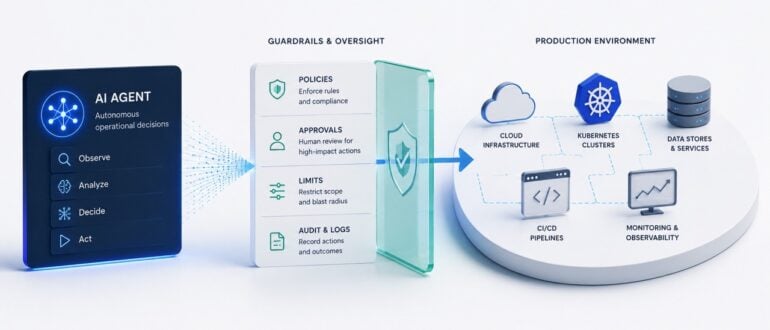
For the last few years, most AI usage in software delivery has been relatively passive. Developers ask assistants to explain logs, summarize incidents, draft deployment scripts, generate Terraform examples, or suggest test cases. These workflows still require a human to decide what runs, where it runs, and when it affects customers.
That boundary is starting to move.
AI agents are increasingly being connected to ticketing systems, CI/CD platforms, cloud consoles, observability tools, runbooks, and infrastructure APIs. Instead of merely suggesting a remediation step, an agent may soon be able to open a pull request, update a configuration value, trigger a deployment, scale a service, rotate a secret, or roll back a release.
That shift is the focus of DevOps.com’s article, When AI Agents Get Production Access: The Next Big DevOps Risk. The core issue is not that AI agents are inherently reckless. It is that production access changes the threat model. Once an agent can act, engineering teams must govern it like any other actor capable of modifying live systems.
For CTOs and platform teams, this is a modernization problem as much as an AI problem. Many organizations still rely on deployment controls designed for human developers, deterministic build pipelines, and relatively predictable automation. Agentic systems break some of those assumptions.
Why Better Prompts Are Not Enough
A common first response to AI risk is to improve prompts: add stricter instructions, define better guardrails, tell the agent not to perform dangerous actions, or require it to explain its reasoning. Prompt quality matters, but prompts are not release controls.
Prompts are advisory. Production controls must be enforceable.
If an AI agent has credentials that allow it to modify a Kubernetes deployment, change a feature flag, or approve a pipeline, then the real control is not the instruction text. The real control is the permission boundary, the audit trail, the policy engine, and the rollback path.
Developers already understand this in other contexts. We do not secure databases by asking application code to be careful. We use least privilege, network controls, schema permissions, backups, monitoring, and change management. The same principle applies to AI agents operating in DevOps environments.
The lesson is simple: treat prompts as part of the interface, not as the security model.
Where Traditional CI/CD Gates Fall Short
Traditional CI/CD gates were built around artifacts, branches, tests, approvals, and deployment stages. That model still matters, but it is not sufficient for production AI systems or agent-driven operations.
The New Stack’s article, Why traditional CI/CD fails for LLMs and the release gates we built to fix it, highlights why AI-enabled systems require a more practical release-gating approach. LLM behavior is not always captured by the same checks used for conventional code. Outputs can vary. Context can shift. Tool use can introduce side effects. A system that passed yesterday’s tests may behave differently when given a new incident, a new prompt, or a new production signal.
For DevOps teams, the issue becomes even sharper when agents are not only producing content but also taking action. A conventional pipeline may verify that a deployment artifact passed unit tests and security scans. It may not answer questions such as:
- Is this agent authorized to take this specific action in this specific environment?
- Is the action safe given the current service-level objectives?
- Has a human approved this class of production change?
- Can we reconstruct why the agent acted and what data it used?
- Can we quickly roll back the change if the agent’s action causes harm?
- Is the agent operating in a sandbox, staging, canary, or full production scope?
These are release-gating questions, not prompt-engineering questions.
What Release Gates for AI Agents Should Include
A practical release-gating approach does not mean slowing every agentic workflow to a crawl. It means defining which actions are allowed automatically, which require approval, and which are prohibited entirely.
Authorization by Action, Not by Tool
Do not grant broad access because an agent needs to use a platform. Grant access based on the specific actions it is allowed to perform.
For example, an incident-response agent may be allowed to read logs, query metrics, and suggest remediation. It may be allowed to restart a non-critical worker in staging. But scaling a production database, changing network policy, or deploying a new container image should require stronger controls.
This suggests a permission model based on verbs and scope: read, propose, create pull request, trigger staging deployment, trigger production rollback, modify infrastructure, approve release. Each should be separately controlled.
Human Approval for High-Impact Changes
Human-in-the-loop approval should not be a vague aspiration. It should be implemented as a gate in the workflow.
For low-risk actions, such as creating a draft pull request or generating an incident summary, the agent can proceed automatically. For medium-risk changes, such as updating a feature flag in staging, approval may depend on team policy. For high-risk production changes, approval should be explicit, logged, and tied to an accountable human.
The important detail is that approval should happen outside the agent’s own reasoning loop. A message that says, “I think this is safe,” is not the same as an enforced approval gate in a deployment platform, change management system, or policy engine.
Environment Scoping and Blast-Radius Limits
Agentic automation should be scoped by environment. Development, staging, canary, and production should not share the same permissions or credentials.
A well-designed agent workflow should make it easy to answer: where can this agent act, and how far can the change spread?
Practical controls include separate service accounts per environment, time-bound credentials, namespace-level restrictions, canary-only deployment permissions, and rate limits on repeated actions. If an agent makes a poor decision, the system should limit the blast radius by design.
Auditability That Explains the Change Path
Audit logs need to show more than an API call. They should capture the full change path: the triggering event, the agent identity, the tools invoked, the data sources consulted, the proposed action, the approval decision, and the final production effect.
This matters for incident review, compliance, and engineering learning. If a production outage follows an agent-initiated configuration change, teams need to reconstruct not only what changed, but why the workflow allowed it.
Auditability is also essential for trust. Developers will be more willing to adopt agentic DevOps if they can inspect and challenge the automation instead of treating it as an opaque actor.
Rollback as a First-Class Gate
If an agent can initiate a change, the release process should verify that rollback is available before the change proceeds.
That may mean ensuring a previous artifact is deployable, a database migration is reversible, a feature flag can be disabled, or an infrastructure change can be reverted. For production AI agents, rollback should not be an afterthought written into a runbook. It should be checked as part of the gate.
This is especially important for modernization programs. Legacy systems often have fragile deployment paths, undocumented dependencies, and limited automated rollback. Giving agents access to those environments without improving rollback capabilities increases operational risk.
Practical Implications for Engineering Teams
Engineering leaders adopting agentic DevOps should start by mapping where AI systems intersect with production controls.
Ask a few direct questions:
- Which AI tools or agents have credentials in our delivery, cloud, observability, or incident-response systems?
- Can any agent trigger a production change directly or indirectly?
- Are agent actions governed by the same approval and audit standards as human actions?
- Do we separate read-only, recommendation, staging, canary, and production permissions?
- Can we roll back every class of agent-initiated change?
- Are our CI/CD gates validating agent behavior, or only validating code artifacts?
The answers often reveal hidden modernization work. Teams may need to update IAM policies, split service accounts, introduce policy-as-code, strengthen deployment metadata, improve rollback automation, or redesign approval workflows.
This is where a software maintenance and modernization mindset helps. At Vibgrate, we see modernization not just as upgrading frameworks or refactoring code, but as improving the operational systems around software. Agentic DevOps makes that broader view essential. If automation is evolving, the controls around automation must evolve too.
A Modern Release-Gating Model for Agentic DevOps
A useful model is to classify agent actions into four levels:
- Observe: read logs, metrics, traces, tickets, and documentation.
- Recommend: propose a fix, draft a pull request, or summarize options.
- Prepare: create changes in a controlled environment, open deployment requests, or run tests.
- Execute: modify production systems, deploy releases, roll back services, or change infrastructure.
Each level should have different gates. Observation may require read-only access and data handling controls. Recommendations require traceability and review. Preparation requires test environments and policy checks. Execution requires explicit authorization, auditability, rollback readiness, and environment scoping.
This model helps teams avoid a false binary between “no AI in production” and “full agent autonomy.” Most organizations will land somewhere in the middle, with carefully delegated automation for well-understood tasks and stronger approvals for high-impact actions.
Conclusion: Agentic DevOps Needs Operational Discipline
AI agents will continue moving deeper into software delivery. That is not inherently bad. Used well, they can reduce toil, accelerate incident response, improve upgrade planning, and help teams maintain complex systems with less manual effort.
But production access changes the rules. Engineering teams should not rely on better prompts to manage production risk. They need release gates built for agentic systems: enforceable authorization, clear audit trails, scoped environments, human approval where it matters, and reliable rollback.
The next phase of DevOps modernization will not be defined only by how much automation teams adopt. It will be defined by how safely they let that automation act.